
Free · Takes about 40 seconds
You're probably doing 3 sets too many.
The first 2 high-effort sets of a movement drive most of the strength and growth. Your muscles are freshest and recruitment is highest. The returns increasingly diminish after the second set.
Answer 4 questions and I'll build you a full training week on those first 2 sets that adapts to your schedule, your equipment, and your experience.
No card. Nothing to install. Your week appears on screen.
The minimum effective dose. The least work that still moves you forward, done every week, for a long time. PMID 20300012 · PMID 27433992
Why it's built this small
I'd rather raise
your floor
than your ceiling.
Anyone can train hard when the week goes to plan and nothing gets in the way. But that's rare. What decides the year is how high your lowest point stays when life gets messy.
A little done every week builds more than a lot done once in a while.
What you'll walk away with
- Your week, laid outEvery session, every lift, sets, reps, tempo and how hard to push.
- How to pick your weightsWithout testing a 1 rep max, and without guessing for a month.
- My warm-upThe same sequence I put my own clients through, plus the cooldown.
- What to do on a bad weekMy floor protocol, so a missed session stops turning into a missed month.
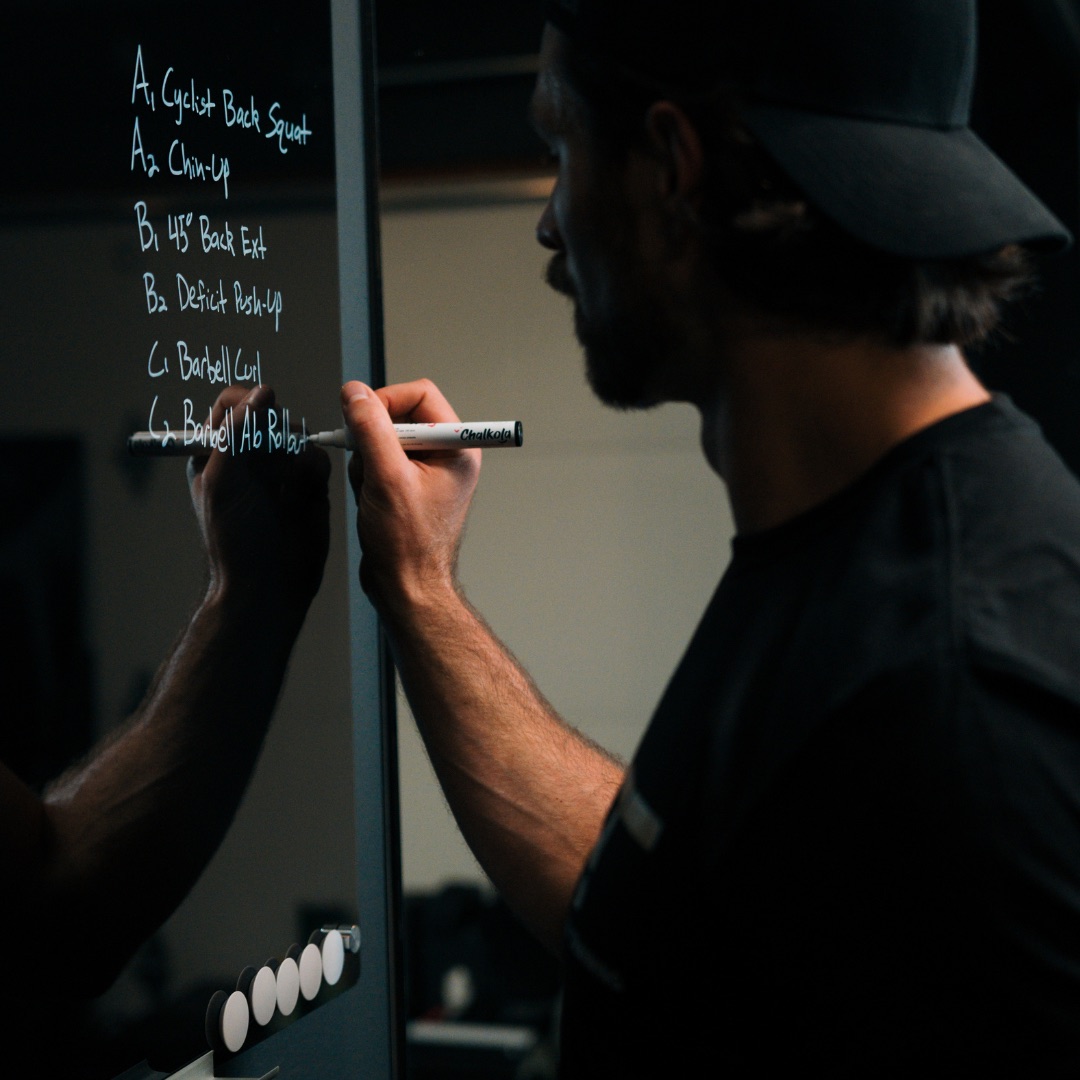
Why I made this
The least I could do.
A few years back, my low-back issues forced me to train less. Then the birth of my daughter made me want to. So I stopped chasing volume and started looking for the smallest amount of work that still did the job. Now that's how I write every program.
What you're about to get is a real sample of it. Same structure, same movements, same progression I write for my clients.

Question 1 of 4
Realistically, how many days a week can you train?
Answer for the week you actually have, not the one you'd like.
How long have you got per session?
Door to door, warm-up and cooldown included.
What can you get your hands on?
Pick the one that matches most weeks.
How long have you been training?
This sets how close to failure your smaller lifts run.
Your week is ready
Your week is on the next screen either way. The email is how you find it again, at the gym or 3 weeks from now, and it carries the 4 week progression and how to pick your starting weights.
One email with the plan, then a few a week worth reading. Leave whenever you like.

Your minimum effective dose
Your week
If a movement is new to you, hit Watch. I filmed every demo on this page, so you're not guessing at someone else's version of it.
How it works
| Compounds | 2-3 RIR |
| Accessories | 1-2 RIR |
| Isolation | 1-2, last set 0-1 |
Effort climbs as the movement gets smaller. The compounds keep their margin because they carry the technique and the spinal load.
A few movements are scored on RPE instead, which is the same idea counted from the other end: RPE 7 is 3 reps in reserve, 8 is 2, 9 is 1, and 9.5 means none left, though the weight could have been heavier.
Warm up properly first, then the 2 sets that count. Both are meant to be hard. If the second feels easier than the first, the first was not hard enough.
21X1 means 2s lowering, 1s pause at the bottom, X is as fast as you can move it up, 1s pause at the top. Slow the lowering down and the set gets much harder without adding weight.
Same movements for 4 weeks. When you hit the top of the rep range on both sets with reps still in the tank, put the weight up next session. Reset to the bottom of the range and climb again.
The parts that decide whether it works
Everything else you need before you begin
Warm up like this, every session
Same sequence every time. Run it continuously, brief rests only if you need them. It should prime you for the main lift, and the plyometric is what does that, so keep it explosive.
Watch the warm-up 1 min 32 sec, the whole sequence
- Elephant Walk Steps 2 x 10 total
- Deep Squat to Hamstring Stretch 2 x 5
- Runner's Lunge with Rotation 2 x 5 per side
- Light hinge, squat, press, row 2 x 3 each with a light DB or KB
- 1 plyometric 3 x 5. Jump, plyo push-up or ball slam. Rest 30-45s. Explosive, never a grind.
Numbers like 2a and 2b mean a superset. Alternate between the two, a push paired with a pull, so nothing sits idle while you rest. A plain number is a straight set, done to completion before you move on.
Then ramp into your first working set: 6-8 reps at 40-60% of it, 3-5 reps at 60-80%, 1-3 reps at 80-90%. Minimal rest between. Your warm-up sets should look identical to your working sets technically.
That ramp only applies when there's a load to ramp with. Training with just your bodyweight, go straight from the warm-up into set 1.
Finish every session the same way
About 5 min, and it counts as part of the session. The hang decompresses the spine and builds grip. The breathing takes you out of fight or flight and into rest and digest, so recovery starts before you leave the gym.
- Passive Hang x 60s
- Box Breathing x 10 nasal breaths. 4s inhale through the nose, 4s hold, 4s exhale through the nose, 4s hold.
Ideally lying on your back, palms up, legs elevated on a bench so your knees form a 90° angle. If you're pressed for time, do just the Box Breathing. It takes 3 min and still makes a meaningful difference in your recovery.
How to pick your first weights
You don't need a max to start. Pinpoint accuracy isn't required here, and a max attempt costs you a session you could have spent training.
Match your first guess to the effort target. On the main lift, pick a weight you could take about 2 or 3 reps past the top of the range. On everything else, 1 or 2 past. Run your 2 sets, then read what happened:
- Plenty left in the tank? Too light. Add 5-10% next session.
- Form broke down before the reps did? Too heavy. Drop 10% and build back.
- Last 2 reps a grind but still clean? That's your weight. Stay there.
Give it 2 sessions. It's common to over- or undershoot the first time. The log finds your numbers.
Food, in 4 numbers
My nutrition work comes down to 2 anchors. Total calories set the direction. Total protein protects the muscle while you get there. Everything else flexes.
- Protein about 1g per pound of your goal bodyweight. Some in every meal.
- Water half your bodyweight in pounds, taken as ounces. A 180lb person drinks about 90oz across the day.
- Deficit, if you're leaning down 250-500 calories below maintenance. No lower. Going harder slows your metabolism and costs you muscle.
Estimate maintenance at your bodyweight in pounds x 14 to 16: 14 if your day is mostly seated, 16 if you're on your feet. Then watch the scale for 2 weeks and adjust. The trend is the answer, the formula is just the starting point. - Fiber 25 to 35 grams a day, from food. Fruit, vegetables, beans, potatoes, oats. It keeps you full while you're in a deficit and keeps your digestion working while your eating changes.
No banned foods, no eating the same 4 meals forever. Get those 4 right and the rest flexes around your life.
What's realistic
A plan usually dies over pace. Expect 4 lbs of fat a week or 5 lbs of muscle a month and a good month will look like a failure. Here are the real numbers.
| Fat loss per week | Of bodyweight | Men | Women |
|---|---|---|---|
| Aggressive | 1 to 1.5% | 2 to 3 lbs | 1.5 to 2.5 lbs |
| Reasonable | 0.5 to 1% | 1 to 2 lbs | 0.75 to 1.5 lbs |
| Comfortable | Under 0.5% | Under 1 lb | Under 0.75 lb |
| Muscle gain per month | Men | Women |
|---|---|---|
| Beginner | 1.5 to 2.5 lbs | 0.5 to 1 lb |
| Intermediate | 0.75 to 1.25 lbs | About 0.5 lb |
| Advanced | About 0.5 lb | About 0.25 lb |
Aim for the reasonable row. The aggressive row costs muscle and rarely survives a normal month.
Hard days, sore weeks, and when to back off
The plan can't see you, so a few rules carry the judgment I'd normally make in the room.
- Two options on any given day Feeling good takes the heavier version. Run down takes the lighter one. Both move you forward, so pick the one that matches the day you're having.
- Anything sharp in the low back Drop to the lighter option and tell me about it. Reply to the email your week came in and it lands with me. Sharp is different from sore, and it's worth saying out loud rather than training through.
- Deload every 4th to 6th week Same movements, less weight and fewer hard sets for a week. It goes in the calendar ahead of time, whether or not you feel like you need it.
On a low day, aim at the bottom of the rep range rather than skipping. An RPE 7 today can feel like a 10 next week, and that's normal.
The week it all falls apart
This is the reason I build the week this small. A program with no answer for a bad week loses you after 3 missed sessions.
When the week falls apart, you don't abandon it and you don't try to make it up. You drop to your floor:
- Hit the main lifts only. 2 working sets each.
- Complete the bodyweight version of the given workout. No gym, no commute.
- Hit your protein goal and 7k steps. Then let the rest go.
A bad week you half did still counts, and it keeps the habit alive.
When you want the other 51 weeks
This is 1 week. ADAPT is the rest of them.
Every month I write the next block around the days and the equipment you've got. Your log and your habits live in the app, and I'm also in there to support you. iPhone, Android or web. $97 a month, cancel anytime.
See what's inside ADAPTThe full demo library is on YouTube at @petertangel. Free, and no sign-up.